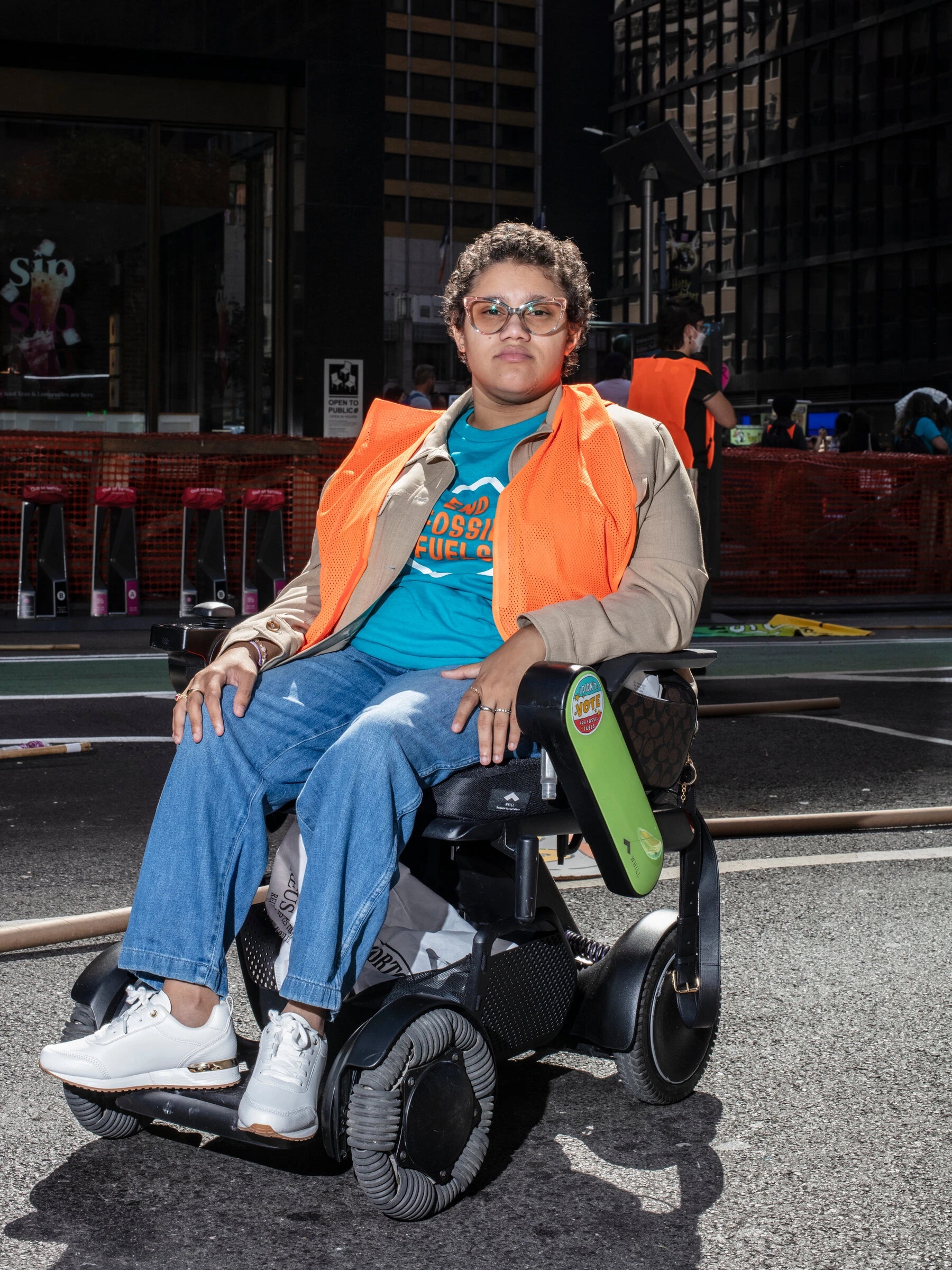
Daphne Frias is a climate justice advocate, storyteller, and disability rights leader whose work centers the lived experiences of communities most impacted by environmental harm. Born and raised in West Harlem, New York City, Daphne's climate advocacy began with the intimate observation that environmental degradation was not an abstract future threat — it was affecting her neighborhood every day. Growing up in a predominantly immigrant community, she witnessed poorer air quality, industrial pollution, and systemic inequities firsthand. These early experiences shaped her understanding that environmental justice is inseparable from racial, economic, and disability justice.
At the core of Daphne's work is a powerful conviction: you cannot address the climate crisis without centering the voices of disabled people. As someone who lives with cerebral palsy and uses a wheelchair, she has long challenged climate movements to go beyond symbolic inclusion and build spaces that are accessible, equitable, and rooted in justice. Her advocacy reframes how climate policy is conceived — not just in terms of emissions and technology, but in terms of health, human rights, and intersectional well-being.
Daphne began her activism in the wake of the 2018 Parkland school shooting, organizing student transportation and later serving as New York State Director of March For Our Lives, where she supported youth engagement on gun violence, voting rights, and civic participation. While this work earned her early visibility, it was her intersectional lens — connecting public health, climate impacts, and systemic inequity — that set the stage for her leadership in climate justice.
By 2019, Daphne had become an official spokesperson for the global climate strikes, which drew millions of participants worldwide. She used this platform not only to call for bold climate policy, but to insist that disabled voices be visible, heard, and prioritized. That same year, she was appointed as a North American Regional Focal Point for Sustainable Development Goal 16 with the United Nations Major Group for Children and Youth, working to elevate youth and frontline perspectives in international policy spaces.
In 2021, Daphne was selected to speak at COP26 through The New York Times Generation Climate Initiative, contributing to global dialogues on leadership, inclusion, and youth-led climate solutions. More recently, she served as lead accessibility consultant for the March to End Fossil Fuels in New York City — an event of over 75,000 participants — ensuring inclusive design and participation for people with disabilities. She also engaged in international youth leadership conversations, including a discussion with U.N. Secretary-General António Guterres at the inaugural Summit of the Future.
Her expertise has been recognized with awards and honors including being named to Forbes' 30 Under 30 North America in Social Impact (2025) — a testament to her influence as a changemaker shaping inclusive climate policy and movement building. In 2025, she was also recognized in TIME Magazine's Latino Leaders collection, which highlighted her efforts to draw connections between environmental racism, health outcomes, and disability inclusion.
Her advocacy extends beyond speaking engagements — Daphne consults with nonprofits, designs inclusive campaign strategies, and mentors emerging leaders. She emphasizes that climate justice requires both institutional transformation and grassroots mobilization: policy change must be paired with community empowerment and the removal of barriers that historically silence marginalized groups.
Today, Daphne continues to redefine what climate leadership looks like. She challenges movements to move past checklist inclusion toward deep structural change that accounts for disability, socioeconomic status, race, and health disparities. Through her storytelling, organizing, and strategic advising, she advocates for policies and practices that ensure no community is left behind in the transition to a sustainable future.
Whether on a global stage or speaking to students in a classroom, Daphne's voice remains rooted in her belief that climate justice is not abstract — it is lived, it is urgent, and it must be truly inclusive.